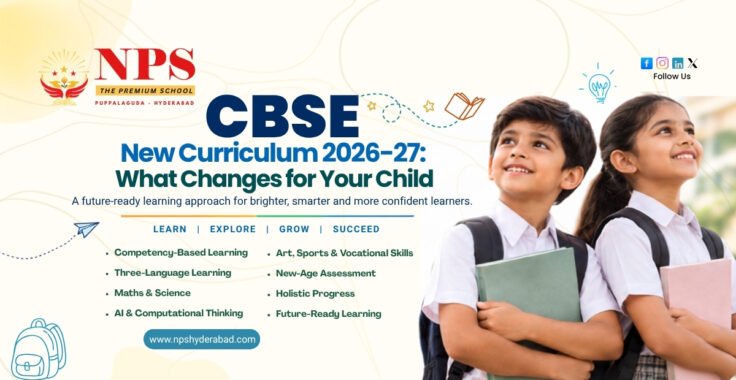
The era of education in India is ushering in a new phase. The Central Board of Secondary Education has introduced its biggest reformation in ten years and as a parent, you should be given a clear explanation in simple language about what this means for your child in class. We at NPS believe that an informed parent is a confident parent and thus here is all you need to know about CBSE Curriculum 2026-27.
Why the Change? and why now?
For years, Indian schooling has relied on the memorization of definitions, not understanding how to apply them, as the guiding principle. With the new curriculum, adopted from the National Curriculum Framework 2023 and the National Education Policy 2020, things are about to change. Emphasis now moves to competency-based learning, thinking and problem solving for children to think instead of recite.
The Three-language Rule Gets Real.
From Class 6 all the students have to learn three languages following a structured R1-R2-R3 mode of learning, of which two languages are to be Indian languages. It’s not simply a policy adjustment, but a real commitment to a more linguistically rich and culturally embedded curriculum, as well as a global fluency in English. Children will have a much more comfortable transition for schools that have a good language department and language-trained staff.
Two Levels in Maths and Science
One of the most talked about changes is the addition of Basic and Advanced levels in Mathematics and Science starting from Class 9. This allows students to take time and depth to suit their learning style and career aspirations, rather than being limited to one difficulty level. A high mark in the Advanced paper will be marked separately on the mark sheet and it will be a positive indicator for further studies and future careers.
Artificial Intelligence is making its presence in the classroom felt early.
One of the more forward-looking changes is the addition of compulsory Artificial Intelligence and Computational Thinking subjects (Classes 3 onwards), with structured modules building up through Class 8 and formal assessment of the board is planned to start in 2029. So children today will not only be using technology, they will be aware of it and how it works, something which the world’s top education systems such as Cambridge curriculum schools have been promoting for years.
Art, Sports and Vocational Skills Are No Longer “Extra”.
The theme for this year’s British and Irish Association of Hospital Education (BIAFE) conference is Art, Sports and Vocational Skills Are No Longer “Extra”.
In contrast to the previous belief that these subjects were not considered “core” requirements, art, PE, and vocational subjects are now required in Classes 9 and 10. The holistic approach acknowledges that a balanced child is a creative child as well as a disciplined child; a view supported by the international school in Narsingi’s philosophy which places a greater emphasis on the whole child than the mark.
Assessment is changing also!
Board exams are gradually making more competency-based questions (case studies, data interpretation, and application-based questions) rather than recall. There will be more emphasis on internal assessment and project-based learning, which will keep students engaged throughout the year rather than preparing for tests at the end of the year. Progress reports will also include information about a child’s personality, leadership and emotional intelligence, as well as academic progress.
For Parents Right Now – What This Means
If you’re considering schools for the next school year, now is the time to consider more than just rankings, and ask the right questions:
- Are the school’s faculty trained for the new curriculum structure?
- Are there real AI, computational thinking and vocational learning facilities?
- Are there Academic and Advanced tracks in the school?
- Does there really seem to be a focus on arts, sports and emotional well beingin addition to academic studies?
For parents who are looking for a Cambridge curriculum school in Puppalaguda or comparing it with a strong CBSE school, the direction of both the systems is converging towards skill based, globally competitive, child centred education. The distinction between “board-oriented” and “international minded” education is becoming increasingly indistinct and it is a welcome change for Indian students.
How NPS is preparing for the Transition
The academic team at NPS has started aligning the pedagogy of our teachers, their training programs and infrastructure with the CBSE 2026-27 framework. We want to do everything that we can to make sure that every child is confident in this new era of learning, not confused.Whether it is strengthening language departments or building AI and computational thinking into the curriculum, we want to do whatever we can to make sure that every child is confident in this new era of learning, not confused.
Educational change can be frightening but it doesn’t have to be. The CBSE Curriculum 2026-27 doesn’t stand in the way, it’s just a chance for your child to be a more inquisitive, capable and future-ready learner.
Need questions answered on the effect of these changes on your child’s classroom this year? Connect with our academic counselors. We’re here to help you make a successful transition one conversation at a time.