
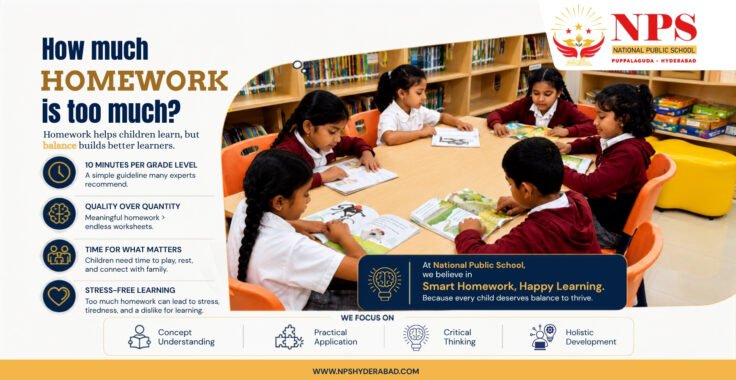
Homework has always been in school life. It facilitates children to improve learning in class, instills discipline and provides parents with a glimpse of children’s learning during the day. In recent years, however, a big question has been on parents’, teachers’ and educators’ minds:
What exactly is too much homework?
This is a question that every school that cares about designing its education for young learners with thought must ask itself, and it is one of the elements that determines how we do it. The key to raising confident, well-rounded children is to find the right balance between practice and play, structure and freedom.
Why homework is important
When appropriate, homework has a number of useful purposes. It will bring reinforcement to the classroom, enable children to learn how to manage their time and promotes independent thinking. A well-designed assignment can convert a passive listener to an active learner, who investigates a concept independently.
But studies have repeatedly demonstrated that too much homework is detrimental. When children have too much homework to do:
- Higher levels of stress and anxiety particularly during primary and middle school years
- Poor sleep that impacts mental performance (concentration, memory and mood),
- Loss of interest in learning, as homework becomes more of a burden, rather than an opportunity.
- More time spent on activities other than physical activity, hobbies and family time, which are all crucial for healthy childhood development.
- Increasing inequity for children receiving and those not receiving at home support
The reality is: more homework equals more learning, not necessarily. It can even backfire on a child’s academic and emotional development, in fact, beyond a certain point.
Too Much? Too Much What?
The “10 minute rule” is used as a general guideline: Approximately 10 minutes of homework per grade level per day. So, for a Grade 3 student, it would be about 30 minutes of homework, and for a Grade 8 student, it would be closer to 80 minutes. If it’s much more than this, particularly for younger children, it might slip into the realm of “too much.
Some signs of a problem with excessive homework are:
- People who have taken numerous hours each day to do homework.Students who have been spending hours after school just doing homework.
- Regularly losing family time and outdoor play opportunities.Regularly giving up family time and outdoor play opportunities.
- Students who seem tired, impatient, or stressed by the deadline
- Parents who must be involved in tasks for their children’s sake.Parents who have to be involved in tasks, just to help children.
- Clear decrease in school interest or motivation value in the child
If these symptoms seem familiar then perhaps it’s time to re-think the homework approach, not only at home, but at a school-wide level.
How to Make it Work in the School Environment
A conscientious school is not just a school that gives out assignments for the sake of keeping students “busy”. Rather, it plans homework with intent, aiming at consolidating the important concepts, fostering curiosity, and valuing the need for rest and play.
This balance is very important to us at National Public School Puppalaguda, Hyderabad. Homework is meaningful, not mechanical and is focused on quality rather than quantity by our teachers. We feel that an evening should allow for reading for pleasure, playing out of doors, being with family and being a child, as well as for age-appropriate academic practice, which should reinforce and extend the learning that takes place in class without overloading young minds.
It’s a broader philosophy of holistic education in which many parents look for when they choose the best international school in Puppalaguda for their child. A really good school recognises that high standards and emotional health go together and that one cannot be achieved at the cost of the other.
Tips for Parents: Supporting without overloading:
Homework is a very important part of students’ education, which is closely linked to their parents.Homework is important in the education of students and is closely connected with the parents.
Here are some tips:
- Establish a consistent homework schedule at a set time and location that will help children to concentrate and complete homework on time.
- Do not hover or do the work for them lead, don’t do. Independence builds confidence.
- Be aware of signs of burnout and talk to your child’s school if you notice your child is consistently exhausted or anxious.
- Offer breaks a short break between tasks makes for better concentration and retention.
- Praise work not just performance to sustain motivation if tasks are difficult.
The Bigger Picture
Finally, homework should be used as a means of reinforcing what the child has learned, not a burden on the childhood years. It is important that assignments are useful, age-appropriate, and balanced with rest, play and family time, and that it is a joint effort between the school, teacher and parent to make this happen.
When parents consider options and look for the best international school in Puppalaguda, one should not only consider academic quality but the attitude of the school towards homework, well-being and the overall growth of the child. This balance is a school with a genuine focus on developing happy, confident, capable learners, a vision we share at National Public School Puppalaguda.