
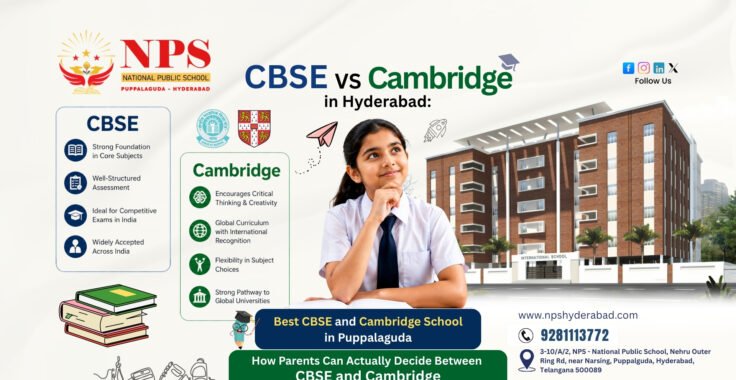
If you’re a parent somewhere around Manikonda, Puppalaguda, Narsingi, or Kokapet and you’ve started school-hunting, you’ve probably run into the same question every family in this part of the city eventually asks: CBSE, or Cambridge?
It’s a bigger decision than it sounds, and honestly, a confusing one to research — because almost every source you find is coming from a school that only teaches one of the two. Ask a CBSE school, and CBSE is obviously the right call. Ask an international school, and it’s obviously Cambridge. Nobody’s really lying to you in either case. They’re just not in a position to be neutral.
So we’ll try to actually be neutral here. Here’s what each curriculum is genuinely good at, who tends to thrive in each — and then a slightly different way of thinking about the whole question, which most parents don’t realize they have access to.
CBSE — what it’s actually built for
CBSE is India’s most widely followed board, and there are real, practical reasons so many families default to it.
For one, it’s built around the country’s competitive exam culture. If JEE or NEET is even a possibility down the line, CBSE’s syllabus and pacing map closely onto what those exams test — there’s no separate bridge course needed later. It’s also just deeply familiar: universities, employers, admission offices across India know exactly what a CBSE marksheet means, with zero explaining required.
There’s a practical side too. CBSE schools are everywhere, so a family relocating within India rarely faces disruption. And the assessment style — periodic tests building toward board exams in Class 10 and 12 — rewards strong content mastery and exam technique, which suits a certain kind of learner very well.
Broadly, CBSE tends to fit families who are fairly sure their child’s future — university, career, everything — will play out in India, especially if that road runs through engineering or medicine.
Cambridge (IGCSE / A-Level) — what it’s actually built for
The Cambridge curriculum — IGCSE through the middle years, A-Level in the final two — comes from Cambridge Assessment International Education, part of the University of Cambridge, and it’s taught in schools across more than 160 countries.
Its biggest strength is mobility. If there’s a real chance your child applies abroad — UK, US, Europe, Singapore, Australia, wherever — Cambridge qualifications are recognized directly by those university systems, no equivalence certificates, no extra paperwork explaining what the grades mean.
The way it assesses students is different too. Alongside exams, there’s real weight given to coursework, research, and written analysis — it tends to reward a child who thinks independently rather than one who’s simply good at recall under pressure. Subject choice opens up more as well, particularly at A-Level, where students narrow down to a handful of subjects and go deep instead of carrying a wide spread all the way through.
This path tends to suit families actively planning — or just wanting to keep open — an international university option, or a child who learns better through inquiry than through memorization and drilling.
The question underneath the question
Here’s something we’ve noticed after enough of these conversations with parents: the real worry usually isn’t “which curriculum is better.” It’s closer to —
What if I lock this in now, and things look different in five years?
A child who’s been on a CBSE track and later wants to apply abroad ends up navigating equivalence certificates and application requirements nobody prepared them for. A child on a pure Cambridge track who later decides to sit JEE or NEET has to catch up on an exam style the school never really aligned to.
Most schools genuinely can’t help with this, simply because they only offer one path — so their advice, however well-meant, always ends up pointing back to whatever they teach.
Where NPS Puppalaguda fits into this
This is where National Public School, Puppalaguda works a little differently from most schools in the Manikonda and Narsingi stretch. We’re a CBSE school in Puppalaguda that’s also affiliated with Cambridge Assessment International Education — so we run CBSE, IGCSE, and A-Level pathways on the same campus, rather than asking families to pick one system before they’ve even started.
If you’ve been searching for a CBSE and Cambridge school near Manikonda, Hyderabad, this is really the practical difference: your child isn’t locked into one system at age five, long before anyone — including them — really knows what they’ll want at seventeen. The domestic exam route and the international university route can both stay genuinely open, for longer than most schools allow. And if your own circumstances shift — a move, a change in plans, a change of heart — that transition happens inside a school your child already knows, not by starting over somewhere new.
It’s a big part of why families researching the best school in Puppalaguda, or simply the best school near Manikonda, Hyderabad, tend to end up considering us alongside the more familiar single-curriculum names.
We’re not going to tell you Cambridge beats CBSE or the other way around, because honestly, for your child specifically, one of them might just fit better — and that’s a conversation worth having in person rather than settling through a blog post. If it’d help, come by for a campus visit. We can walk you through both pathways properly and help you think through what makes sense for your family, including whether keeping both doors open is the right call.